
Jazz Memorial for Andy González
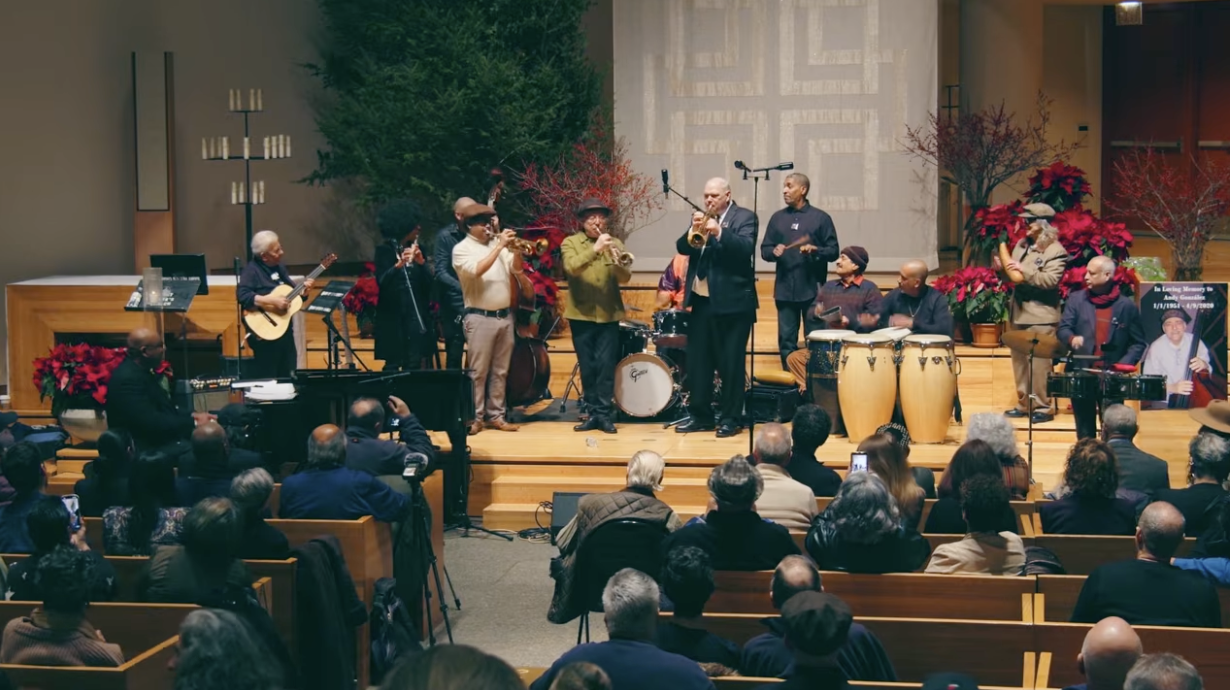
On the evening of January 6, 2026, Saint Peter’s Church opened its doors to musicians, friends, family, and listeners from across generations to honor the life and legacy of Andy González—a towering figure in Afro-Latin jazz whose music shaped the sound of New York for more than five decades. What unfolded was not simply a concert, but a communal act of remembrance: stories told through rhythm, harmony, and the deep listening that Andy himself embodied throughout his life.
Born on January 1, 1951, in the South Bronx to a Puerto Rican family, Andrew González came of age within the vibrant Nuyorican diaspora. His childhood was immersed in sound—Cuban and Puerto Rican music drifting from apartment windows, jazz pulsing through clubs and social halls, Afro-Caribbean rhythms woven into daily life. Music was never abstract in the González household. It was communal, cultural, and inseparable from identity. His father, Jerry González Sr., a singer, instilled in his children a respect for music as inheritance, while his mother, Julia González Toyos, ensured that Andy and his brother Jerry received strong formal musical training through New York City’s public school system.
That combination—homegrown tradition and rigorous education—defined Andy González’s artistry. Alongside his older brother Jerry, his lifelong musical partner, Andy became a devoted listener early on, attending weekly listening sessions hosted by neighborhood record collector and Cuban music expert René López. Those gatherings functioned as an informal conservatory, shaping the brothers’ deep historical and critical understanding of Afro-Cuban music long before they stepped onto professional stages.
Andy’s own musical path took a decisive turn when, after beginning on violin, he switched to bass in elementary school. The instrument became his voice. Under the mentorship of bassist Steve Swallow, Andy learned to approach the bass as a melodic and conceptual force, not merely an accompaniment. By the time he graduated from the High School of Music & Art in 1969, he was already working professionally, soon joining Ray Barretto and then Dizzy Gillespie—an extraordinary launch into a career that would span genres, continents, and generations.
Throughout the 1970s, Andy González became central to some of the most innovative developments in Latin music. His work with Eddie Palmieri, including landmark recordings like Superimposition and Harlem River Drive, expanded the language of salsa through jazz harmony, funk, and social consciousness. With Palmieri’s band he met drummer Manny Oquendo, a collaboration that would shape much of his artistic life. Together with Jerry González, they formed Conjunto Libre, where Andy served as music director, helping forge a daring, intellectually expansive yet deeply danceable sound. Around the same time, the González brothers helped launch Grupo Folklórico y Experimental Nuevayorquino, reconnecting contemporary audiences with Afro-Cuban and Puerto Rican folkloric roots while opening new experimental paths.
Perhaps the most transformative chapter of Andy’s career began in the 1980s with Jerry González & The Fort Apache Band. Conceived as a true synthesis of Afro-Latin music and bebop, Fort Apache dissolved genre boundaries, allowing swing and clave to coexist naturally. While Jerry fronted the band, Andy was its rhythmic anchor and architectural mind, grounding complexity with clarity and depth. The group’s appearance in Fernando Trueba’s film Calle 54 brought their sound to an international audience, but for those who knew the music intimately, Andy’s presence had always been unmistakable.
Even as his career encompassed more than 800 recordings and collaborations with legends ranging from Tito Puente and Cachao to Jaco Pastorius and Astor Piazzolla, Andy González remained deeply committed to mentorship. After a serious health crisis in the mid-2000s temporarily forced him away from performing, he returned with renewed purpose. In 2015, he released his first solo album, Entre colegas, produced by Zaccai and Luques Curtis—two of the many musicians he had mentored, and who also coordinated the music for this memorial. The Grammy-nominated album stood as a testament to Andy’s generosity, bringing together longtime collaborators and a younger generation carrying forward his vision.
The memorial was filled not only with extraordinary music, but with gratitude—for a life devoted to listening, teaching, and building bridges between traditions. In a space long known as the “Jazz Church,” Andy González’s music felt at home, resonating beneath the vaulted ceilings as a reflection of New York itself: complex, restless, and profoundly human.